The Question Remains
Revisiting existentialism from lived experience

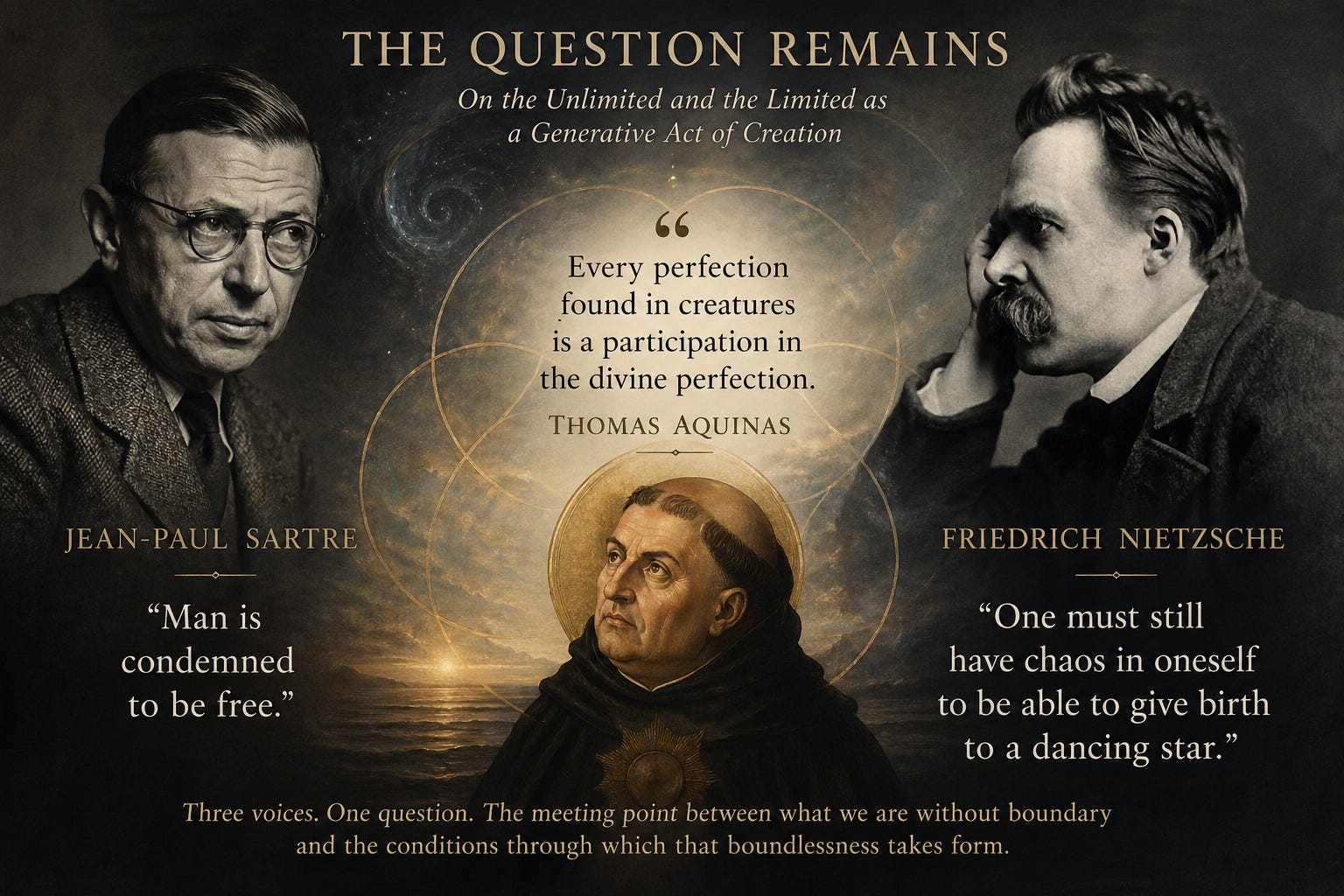
“Man is condemned to be free.”
— Jean-Paul Sartre
“One must still have chaos in oneself to be able to give birth to a dancing star.”
— Friedrich Nietzsche
I came of age in the late 1960s and early 70s, in a cultural atmosphere quietly saturated with the possibility of annihilation. The threat of nuclear war was not always spoken, but it was present as an undertone shaping the emotional climate. There was a sense, not fully articulated but widely felt, that everything could end abruptly, without resolution.
Into that atmosphere I came across names like Jean-Paul Sartre and Friedrich Nietzsche. I encountered them as a teenager, too young to grasp their philosophical depth, but still able to feel their impact. Ideas about the meaninglessness of life, the absence of inherent purpose, the burden of freedom didn’t arrive as carefully reasoned positions. They became something we could wear—an expression of the inner conflict of adolescence—creating a mood that seemed to confirm what was already in the air.
I flirted with these ideas but never fully engaged with existentialism at that point. It was more that my own teenage angst recognised the territory. The sense of groundlessness—of not knowing what any of this ultimately meant—was already there, culturally and emotionally. The philosophy simply gave it language, even if I could only half-follow what was being said.
From the vantage point of this moment in time, looking back and revisiting these ideas feels very timely. We live in a moment where systems of thought that once required years of study can be brought into immediate conversation—compressed, compared, and explored with a fluidity that would have been unimaginable when I first encountered these ideas. What follows is not an academic treatment of Sartre or Nietzsche, but a lived re-engagement with their questions from the perspective of a life fully lived.
If there is a difference now, it lies less in interpretation than in orientation. Where much of existentialism begins from tension, fragmentation, or the absence of inherent meaning, my own understanding has come to rest in a recognition of wholeness as prior. From that perspective, some of the knots that once appeared intractable begin to loosen—not because they are resolved conceptually, but because they are held within a wider field in which tension itself becomes generative rather than combative.
Looking at the world now, it is hard not to feel that some of the conditions these thinkers described have become deeply relevant once again—only this time at scale. The structures that once held meaning in place—religious, cultural, even epistemic—are showing signs of strain, even fracture. At the same time, the technologies through which we encounter the world are increasingly capable of fragmenting attention, distorting perception, and dissolving any stable sense of shared reality.
There is also a further tension emerging within this landscape. As the burden of making sense shifts increasingly onto the individual, a new vulnerability appears. The search for meaning does not unfold in a neutral space. It takes place within systems that shape attention, amplify certain signals, and subtly direct orientation, shaped by the ubiquitous presence of rapidly evolving technologies.
The last century offers its own quiet warning. The collapse of shared meaning did not only give rise to philosophical inquiry. It also opened the door to movements that promised certainty in its place—outsourcing meaning to structures that claimed to resolve the tension once and for all. The risk is not simply confusion, but capture: that the very impulse to make sense of existence becomes redirected before it has the chance to deepen into genuine understanding.
In that sense, the existential mood I absorbed as a teenager—once worn almost as a posture—has intensified into a broader crisis of meaning permeating everyday experience. The groundlessness that Jean-Paul Sartre wrestled with, the collapse of inherited meaning that Friedrich Nietzsche announced—these are no longer abstract concerns. They are lived, often unarticulated realities that increasingly carry the flavour of panic—one that can drive a grasping for certainty, even at the cost of depth or truth.
This raises a deeper question. Were these thinkers describing the fundamental nature of human existence—or were they encountering the early tremors of a larger shift, one that we are now living through more fully? And if the latter, is the apparent collapse of meaning an endpoint, a moment of deep cultural risk—or the exposure of a deeper ground that had previously been obscured?
In recent years I’ve found myself reading more widely, drawn to thinkers working at the edge of how we understand and respond to our current situation. In that context, I re-encountered Sartre and Nietzsche as archetypal voices articulating something essential about the human condition under pressure. That re-engagement sparked a deeper curiosity—not only an appreciation of my earlier naivety, but a more immediate question: how does their thinking stand when viewed through lived experience? And just as importantly, does my own understanding—formed not through philosophy but through an examined life—hold up in the face of their insights and critiques?
It was through my writing—following what some might describe as an awakening experience—that I first began to articulate this tension directly. Again and again, I found myself circling the same question: how does one live as an embodied human being while knowing oneself, at a deeper level, as without limit—without boundary, dimension, or fixed identity? What became clear was that this was not a problem to be solved, but an ever-moving threshold to be inhabited. The apparent contradiction between the limitless and the limited revealed itself as generative—the point at which the formless expresses itself into form, carrying a sense of infinite potential not yet realised.
In returning to Sartre, I began to recognise that he too was grappling with this threshold. His distinction between the for-itself—consciousness as open, indeterminate, without fixed essence—and the in-itself—the solid, given conditions of existence—maps closely onto the same terrain. But where my own experience led toward a sense of participation, Sartre experienced this division as fundamentally unstable, even catastrophic. The human being, in his account, is caught between an ungrounded freedom and the brute limits of existence, with no underlying coherence to reconcile the two.
What appeared, in his framework, as an irreconcilable split began to reveal itself, in my lived experience, as a dynamic interface—one that did not require resolution, but conscious and curious participation.
Reading Sartre more closely, it is clear that his account does not collapse into nihilism, but it moves close to its edge. If there is no given meaning, no underlying order or intelligence to reality, then the burden shifts entirely onto the human being. We are not only free, we are responsible for generating meaning in a universe that offers none in return. That is the weight carried in his claim that we are “condemned to be free.”
From within that frame, the tension between the limitless and the limited cannot resolve. It becomes a permanent instability. Consciousness exceeds every definition, every role, every attempt to fix it, yet remains embedded in conditions it did not choose. The result is a kind of ontological instability. Meaning is possible, but it must be constructed against the background of an indifferent reality—fragile, provisional, and always under revision.
My own experience led in a different direction—not as a counter-argument, but as a shift in what is directly perceived. What opened was not a void to be filled, but a sense of reality as already whole—alive, present, and irreducibly intelligent in ways that cannot be captured conceptually. From that vantage point, meaning is not something imposed onto a lifeless universe, but something that arises within a field of participation. The tension between the unbounded and the bounded does not disappear but is no longer experienced as rupture. It becomes the very condition through which life expresses itself—each moment carrying a sense of unfolding potential, not yet realised but already active.
This is difficult to articulate without it sounding like a metaphysical claim. It is not intended as one. It is simply the ground from which my understanding now operates. Without acknowledging that shift, what follows would reduce to an argument between ideas. With it, the question becomes more precise: what if the groundlessness Sartre describes is not the final condition, but what it feels like when inherited structures of meaning fall away, before a deeper coherence becomes available? And whether we can remain with that emergence without prematurely closing it down by imposing meaning.
If Sartre leaves us suspended within the tension, Nietzsche moves decisively in another direction. Where meaning is not given, it must be created—not as a burden, but as an act of strength. He does not attempt to resolve instability; he intensifies it. Life, in his account, is not something to be reconciled, but something to be affirmed in all its contradiction and becoming. The collapse of inherited meaning is not a loss, but an opening for new values, forged through the will to power—the drive of life to express, expand, and overcome itself.
There is something deeply compelling here, and I recognise a resonance in my own experience. In contrast to Sartre’s gravity, Nietzsche introduces a fierce vitality—a refusal to retreat into despair. His notion of amor fati, the call to love one’s fate entirely, aligns in part with my own starting point of non-resistance. And yet, even here, a difference emerges. For Nietzsche, tension remains fundamentally agonistic—structured through struggle, overcoming, and assertion. The individual must rise to meet the chaos, shaping meaning through strength of will.
From where I now stand, the same field of tension appears differently. The creative movement is still present, but it does not arise through opposition so much as through participation. What Nietzsche experiences as something to overcome begins to reveal itself as something to be included—not passively, but as part of a larger unfolding coherence. The impulse toward creation is not driven solely by force, but by alignment with the movement of life itself. The question shifts from how to impose meaning, to how to recognise and respond to the intelligence already at play.
What becomes clear is that the tension both Sartre and Nietzsche grapple with does not need to be resolved conceptually. Their questions are valid—they sit at the heart of human experience—but they cannot be answered by thought alone. They must be lived and lived from a different starting point.
Where their thinking begins from fragmentation or absence, my own experience rests in a recognition of wholeness as prior. This is not an idea, but something revealed through direct attention and a sustained curiosity. When resistance falls away, what remains is not emptiness, but presence—already whole, already complete, and continuously unfolding.
From this perspective, the opposition between the limitless and the limited falls within a greater integration. The unbounded is not elsewhere, nor in conflict with embodiment. It is expressed through it. The constraints of form are not obstacles, but the medium through which potential takes shape. What once appeared as contradiction becomes a living threshold where something new can emerge.
This does not remove tension. It relocates it. The edge is no longer in asserting meaning against an indifferent world, but in remaining present within the unfolding of experience without collapsing it into certainty. There is a demand here—not for force, but for sensitivity; not for control, but for participation.
Meaning, in this light, is not constructed in isolation nor wrestled from a silent universe. It arises in relationship between what is given and what is possible. Each moment carries potential, not yet realised, yet already shaping what comes next.
There is also a felt sense—difficult to capture conceptually—that life is not merely happening but expressing. One is less an isolated agent and more a vehicle through which something moves: an impulse toward form, toward connection, toward expression. This is not a belief imposed on experience, but something discovered within it. And from here, the question shifts. It is no longer how to create meaning in a meaningless world, but how to recognise and respond to the intelligence already present within the unfolding of life itself.
Seen in this way, the collapse of inherited structures of meaning—whether philosophical or cultural—is not a loss, but an opening. It is an invitation into a different way of relating to experience, one that cannot be fully articulated, but can be lived.
Postscript
It would be easy to leave the story with Sartre and Nietzsche, but the question they brought into such sharp focus does not end with them. Subsequent thinkers such as Martin Heidegger and Maurice Merleau-Ponty, continued to explore Being, embodiment, and the relational field in which experience unfolds.
This is not a new question. It has taken many forms across history, from Aquinas’ notion of participation in the divine to the existential crises of modernity.
But there is also something to acknowledge in Sartre and Nietzsche themselves. They did not allow easy consolation. They stripped away inherited certainties and insisted that the question be faced directly—without appeal to ready-made meaning. In doing so, they forced a level of honesty that remains essential.
And so, the question they leave us with may be the one that remains: how does the unlimited engage with limitation? Or more intimately, what is the role of the human being within that movement?
However it is framed, it returns us to the same living edge—the meeting point between what we are without boundary and the conditions through which that boundlessness takes form.
“Every perfection found in creatures is a participation in the divine perfection”
— Thomas Aquinas, Summa Theologiae (paraphrased)
I appreciate other substack writers exploring these bigger questions of meaning and purpose. And it was a nice synchronicity with an article I have in draft that explores similar themes prompted by reading I’ve been doing on the holofractal nature of existence, the patterns present at all scales, and the sharing of information with the whole. What does life look like when we live from that perspective? Not from a framing as limited but as intricately and instantaneously connected to an ever-expanding consciousness. Not as a spider on the web, but the web itself. When wholeness is not a merging or dissolution, but a recognition of relationship. How does that knowing shape a human life?
Wow.. thanks.. that was a fascinating read for Sunday morning with a cuppa in bed! I've never studied these philosophers… so don't have much understanding from my own reading of what they were saying. But your summaries were good enough for me. what rang true for me was the impact of that Foundational experience of wholeness on our experience and understanding of the world… and our participation in it ,..and the way you emphasized, not rejecting the unpredictable and challenging tension in that unfolding… but instead engaging and embracing it. ..